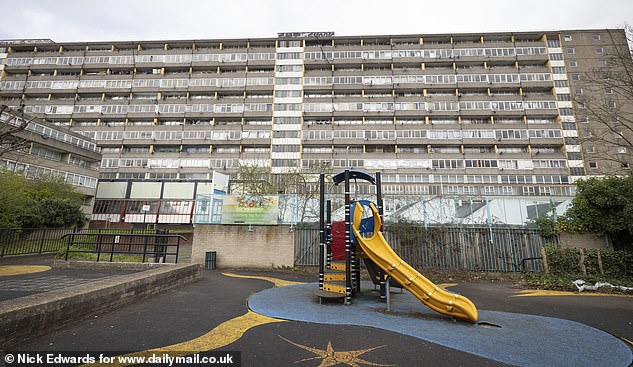
‘We find people having sex in the lifts, doing heroin and crack cocaine,’ a security guard says as he strolls over the road.
He has just finished his hourly patrol of the vast concrete carcass looming behind him.
‘Sometimes there are people sleeping in the flats – squatters – then we have to call the police. There have been lots of fires as well.’
He is describing the scene inside one of the Wendover blocks on the Aylesbury estate in Walworth, south London.
Of the 240 flats, just six still have tenants, while the sister block is completely empty. That’s because they are going to be knocked down, along with all the other original buildings on the estate. When that will happen is another question.
Aylesbury, which housed more than 10,000 at its peak, is one of the largest and most notorious council estates in the country. It has featured countless times on screen, providing a gritty backdrop for shows such as The Bill and Luther.
It was the stage for Tony Blair’s first major speech as Prime Minister in 1997, when he declared from one of its stairwells that there would be no ‘forgotten people’ in his vision of Britain.
Southwark Council decided in 2004 to rebuild the whole estate, enlisting developers Notting Hill Genesis for the bulk of the colossal task.
But after repeated failures to hit targets, that partnership finally collapsed this month. All the while, remaining residents are left to live among the abandoned buildings, wondering what comes next.

A playground stands empty in the shadow of one of the Wendover blocks on the Aylesbury estate in Walworth, south London

All the original blocks on the estate are due to be demolished, making way for a higher number of new homes

Graffiti sprayed on top of one of the Wendover blocks calls for the authorities to prioritise people over profits

Loretta (right), with her granddaughter Bobbie, has lived on the estate since 1977 and says it is ‘terrible’ now
When the Daily Mail visited the estate last week, there were few people to be found walking the streets.
But we did meet Loretta, a pensioner who still lives on Aylesbury after moving there in 1977, almost 50 years ago.
She told us: ‘This is my area. I had a friend who lived in the Wendover block and they were lovely flats. Nice big kitchens. But they told everyone they had to move out, and everything went downhill. It’s terrible now.’
Accompanying Loretta was her granddaughter, Bobbie, who added: ‘It feels now like the stereotype of a council estate. You never used to feel the shame of living here. But now, you’ve got dumping grounds everywhere, people using drugs and fights.
‘They’ve blocked off the empty buildings because rough sleepers kept starting fires. But if they’d kept the people in there – maybe done it up, and worked on it – then it would be alright.’
This is a popular idea among tenants. Many have argued from the start that the flats could be retrofitted, rather than knocked down.
But Southwark Council insisted it was more economical to start again, signing a blueprint from Notting Hill Genesis in 2014 to rebuild the estate with 4,200 new homes by 2036 – with the total project estimated at £1.5billion. Now, the council must find new partners to finish the job.
Neither party will go on record to explain what went so wrong that more than half of that deal has been torn up, but the council admitted ‘progress has been too slow’, and this has caused ‘serious problems including anti-social behaviour in and around the vacant blocks’.
With £350million spent so far, fewer than a quarter of the new homes have materialised, and more than a third of the original dwellings stand empty, awaiting demolition that has repeatedly been delayed.
Join the debate
How should London tackle neglected estates that breed crime while regeneration plans stall?

The estate housed more than 10,000 people at its peak across 2,700 homes, and is set to be replaced with more than 4,000 new dwellings

Tony Blair gave his ‘forgotten people’ speech from the Aylesbury estate in 1997

The abandoned blocks are identifiable by smashed windows, with residents complaining they cast a sinister atmosphere

Piles of rubbish have been dumped in dingy corners of some of the blocks, which has attracted vermin
As residents were moved out, squatters and drug users moved in. A council document showed that, in July last year, 48 flats across the estate were occupied by squatters.
In October, Ketzia Harper, a councillor for the local Faraday ward who lives on the estate, told Southwark News: ‘In the last two years I have encountered, in the less populated parts of the estate, metal doors ripped from their door frames whilst shattered glass, human excrement and used needles litter the floors.’
A major operation was launched by the council in partnership with police, homelessness charities, gang crime experts and drug specialists to tackle the ‘out of control’ antisocial behaviour.
This involved a team of more than 80 people checking the hundreds of empty flats and sealing them up with metal sheets.
Now, security guards patrol the site 24 hours a day, with dogs used as an added deterrent. But with so many dark corners, it has been impossible to root out the problems entirely.
Denise Williams lives on the estate, and said her front door was kicked in by squatters searching for an empty property to take over.
She told us: ‘I was in the kitchen on the top floor and heard the sound, but my grown-up kids were downstairs. Whoever it was saw the house was lived-in, so moved on. But it was still scary – and definitely would have been worse if I were home alone.
‘There used to be lots of families on the estate, and all the sons and daughters would go to the local primary schools. But many of the families have moved out now.’

Denise Williams lives on the estate, and called for greater transparency about what the future of Aylesbury looks like

A decision was taken in 2005 to knock down every block on the estate, with Notting Hill Genesis initially committing to rebuilding over 4,000 homes

Workers reinstalling metal panelling to seal off a flat, after squatters managed to break in

Residents have become used to parts of the estate being taken over as building sites
As the local representative for Citizens UK, Ms Williams has experience standing up for the needs of residents in temporary accommodation to the council. She said that Southwark Council is aware of the need for ‘decent homes’ and makes an honest effort to deliver them – but sometimes needs ‘spoon-feeding’.
Ms Williams stressed that the most important question to ask of the new plans concerns the proportion that will be council houses.
She said: ‘Southwark Council has announced they’re building thousands of new homes here, but the real question is, who can afford them?’
‘If people are being moved out of council houses, and they are being replaced with a higher number of private residences – that’s a problem. We also want to know, what’s the plan now, and what went wrong in the partnership with Notting Hill Genesis?’
The council says the development meets the requirement that at least half the new homes are affordable, and that it has bought 581 of the 703 homes so far built by Notting Hill Genesis to lease out as council houses.
Ms Williams also backed considering alternatives to demolition. It was estimated in 2005 that fully retrofitting the estate would cost £350m, exactly the same amount as has been spent to date – although the former figure would now be higher, accounting for inflation.
One can understand the scepticism about the future of the development. Residents of Aylesbury have got used to broken promises.
When it was built in the late 1960s and early 70s, its concrete expanses and ‘walkways in the sky’ were touted as a modern British success story, where the poor were to be supported by access to decent social housing.
With more than 2,700 homes across dozens of large blocks, it was one of the largest council estates in Europe – but its decline has since become a symbol of the long-term failures of the post-war housing project.
Life grew darker on Aylesbury during a period of decline in the 1980s, and it became synonymous with crime and urban decay. Delays to the regeneration in recent years have only exacerbated those problems, and sucked the soul from the remaining original areas.
Pranith Raddy, 25, a barman at The Hour Glass Hotel in the heart of the estate said: ‘I’ve worked here for three years, and it does feel like the pub has lost customers in that time.

Pranith Raddy, 25, works behind the bar at the Hour Glass Hotel in the centre of the estate, and says they have fewer customers since residents have been moved out en masse

One of the Wendover blocks on the Aylesbury Estate in Walworth, south London, where security teams have been brought in to root out squatters

Gurpreet Singh owns a convenience store, and says barely anyone visits his shop from the direction of Aylesbury estate anymore
‘Most of our regulars come from the estate, so when people are moved out, we have fewer people coming into the pub.’
Tommy, 75, lives in one of the six last occupied flats in the Wendover block, after moving onto the estate 44 years ago.
Waiting for a bus on Thurlow Street, he said: ‘It was quite a desirable place to live, when I first moved in. Nice, smart flats and just a good place to be.
‘But this whole regeneration has been a shame, you only need to look around.’
Gurpreet Singh, 36, who owns Grove Food and Wine on the outskirts of the estate, said: ‘Business has become very hard for us here. The only reason we’re able to keep going is because we have two shops, and the other one is profitable. At this site, we are just scraping by. Everything we make goes back into the shop.
‘We used to get people coming to us from both sides – now very few people come to use from the estate. It’s hard.’
‘When they first started talking about knocking down the buildings, we thought it would happen quickly. But now, they’re just standing there empty, and all the customers have gone.
‘One of the nearby buildings was supposed to be demolished in August, but it’s still standing there empty. They’ve tried to board it up, but some people have got in and are up to no good.’
Michael Abeyemi, 24, moved into one of the Wolverton blocks when he was 13. He said: ‘I really like this area, but the estate itself is dead now.
‘It’s not nice to have all these empty buildings waiting for demolition. It’s quite draining having them there with nothing being done.
‘There used to always be kids around playing football, but not anymore.’

This is one of the three sites Notting Hill Genesis has committed to finishing, and work is nearly done

Nobody was to be found in any of the play parks on the estate, with many of the families having moved out

Excrement could be found on a number of the walkways on the outside of the blocks
So far, Notting Hill Genesis has built 703 homes, with another 321 currently under construction. It has also delivered new community facilities, notably the Una Marson Library and the Harold Moody Health Centre.
It has committed to finishing off the three phases of the project that it has already started. Two of those are almost complete, while the proposal for Phase 2B, which includes the empty Wendover block, is still awaiting planning permission from the council.
Cllr Sarah King, Leader of Southwark Council, said: ‘The Aylesbury Estate is at the heart of our borough, and we’re determined to build the community that residents and future generations deserve.
‘This is one of the most complex regeneration schemes anywhere and in partnership with Notting Hill Genesis, we’ve delivered 581 new council homes and fantastic new spaces like the Una Marson Library and Harold Moody Health Centre, and open spaces to be enjoyed by generations of Aylesbury residents.
‘But we also know many residents have raised concerns that progress has been too slow and this has caused serious problems including anti-social behaviour in and around the vacant blocks on the estate.
‘We and Notting Hill Genesis share these concerns and have decided to take action to move ahead more quickly. We’re strongly committed to working with estate residents on what comes next on later phases on their estate.
‘I especially want to thank the Chairs of the Aylesbury Estate’s Tenants and Resident Associations, past and present, for their vital work and passionate commitment to the community.’
Matthew Cornwall Jones, Chief Homes Officer at Notting Hill Genesis, said: ‘For us, residents are at the heart of the Aylesbury estate regeneration and these changes will allow NHG to continue to build high quality, energy efficient homes that meet and exceed modern standards, while ensuring long-term social and economic benefits for the community.
‘Since the partnership between Notting Hill Genesis and Southwark Council was established in 2014, we’ve built over 700 homes on the estate, 581 of which the council has bought to utilise as council homes.
‘We’re looking forward to receiving final planning permission from Southwark Council, in order to start moving on with phase 2B.
‘This will allow us to deliver a further 640 high quality new homes to the estate, replacing outdated buildings with modern, spacious housing.
‘Half of these new homes will be affordable, and the majority of those will be family sized. The new neighbourhood will sit within beautifully transformed, greener public spaces for residents to enjoy.’