



Conny Waters – AncientPages.com – Scientists have recently uncovered a fascinating finding that challenges traditional views of evolution.
According to a new study conducted by researchers from Lund University and the University of Sussex, all vertebrates—including humans—share a common ancestor known as the “tiny cyclops.” This ancient creature had a single eye positioned at the top of its head.
The research further reveals that, over time, this median eye evolved into what is now known as the pineal gland in our brains. This discovery provides valuable insight into the evolutionary history shared by all vertebrates.

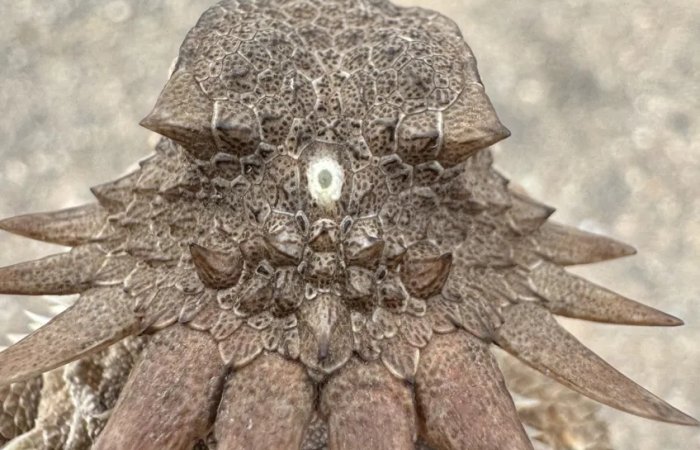
The light spot located in the center of the lizard’s head is known as the median eye. In this image, the lizard’s regular eyes are not visible because the photograph was taken from behind. Credit: Bruno Frías Morales/iNaturalist/Creative Commons
“The results are a surprise. They turn our understanding of the evolution of the eye and the brain upside down,” says Dan-E Nilsson, Professor emeritus in sensory biology at Lund University in Sweden.
This cyclops-like creature, a distant relative of humans, lived nearly 600 million years ago. It was a small, worm-shaped organism that led a sedentary lifestyle and fed by filtering plankton from seawater. Interestingly, earlier in its evolutionary history, this organism possessed paired eyes similar to those found in many other animals.
“We don’t know whether the paired eyes in our branch of the evolutionary tree were just light-sensitive cells or simple image-forming eyes. We only know that the organism later lost them,” says Nilsson.
As the worm-like creature adopted a more tranquil lifestyle, it no longer needed paired eyes, leading to the gradual loss of this function through evolution. Despite this change, the animal retained a cluster of light-sensitive cells at the center of its head. Over time, these cells evolved into a simple median eye capable of distinguishing between night and day and detecting orientation.

A few species of vertebrates still have the old occipital eye on top of their heads. In this frog, the occipital eye appears as a small light blue spot between the normal eyes. Credit: TheAlphaWolf/Wikimedia Commons
Millions of years later, as our distant ancestor returned to an active, swimming existence, renewed evolutionary pressure favored the development of paired eyes. According to researchers, these new image-forming paired eyes eventually developed from parts of the small median eye to meet these demands.
“Now we finally understand why the eyes of vertebrates differ so radically from the eyes of all other animal groups, such as insects and squid. The film of our eyes—the retina—developed from the brain, whereas the eyes of insects and squid originate in the skin on the sides of the head,” says Nilsson in a press release.
Vertebrate eyes represent a more advanced evolutionary model that developed as a result of a unique evolutionary route involving the sedentary lifestyle of ancient cyclops-like organisms.
Researchers reached the conclusion that our modern eyes evolved through this specific pathway—rather than from another ancient animal—by conducting comprehensive analyses of light-sensitive cells across all animal groups. They also examined the physiology and anatomical placement of these cells within various bodies, providing strong evidence for this evolutionary trajectory.
“For the first time, we now also understand the origin of the neural circuits that analyze the image in our retina,” adds Nilsson.
See also: More Archaeology News
A fascinating fact is that remnants of the ancient parietal median eye from our distant ancestor actually remain in our heads today, transformed into the pineal gland. The pineal gland is a light-sensitive organ in the vertebrate brain. It produces the hormone melatonin, which helps regulate the body’s circadian rhythm.
“It’s mind-boggling that our pineal gland’s ability to regulate our sleep according to light stems from the cyclopean median eye of a distant ancestor 600 million years ago,” concludes Nilsson.
The study was published in the journal Current Biology
Written by Conny Waters – AncientPages.com Staff Writer