



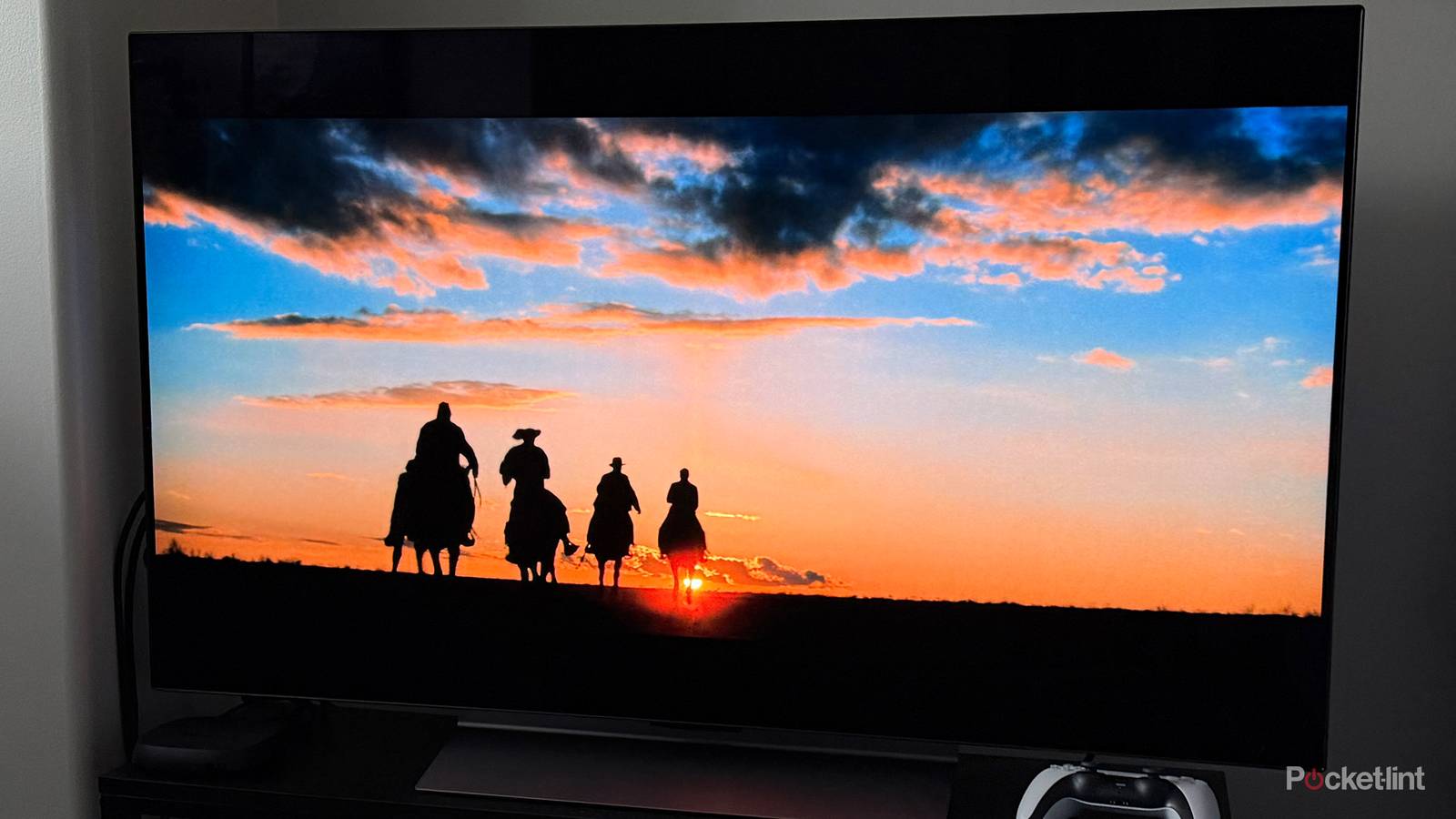
If you were to ask the average home theater enthusiast what the peak of HDR is, they probably wouldn’t hesitate for a second to say Dolby Vision. No doubt some of this has to with marketing and prestige, but its specs legitimately put it above HDR10 and HDR10+ when the tech is firing on all cylinders. Apparently, Dolby executives weren’t happy with their near total control over surround sound via Dolby Atmos.
Vision does, however, run into problems occasionally, to the extent that you may sometimes want to switch it off — or your devices may switch it off for you. That might seem crazy, but in retrospect, Dolby and its licensing partners may have been overly ambitious about bringing the best possible HDR to the home market.
Some scenes can become extremely dark
A story of temporary and permanent fixes

The whole purpose of HDR is enabling the widest possible range of visible shadows and highlights in an image. It makes scenes “pop,” and people like myself would argue that it’s actually a far more important feature than 4K resolution. You need a huge TV to see the difference between 4K and 1080p, but even a 42-inch HDR set can legitimately improve a movie like The Witch or The Wicker Man.
One of the most frequent complaints about Vision, however, is that it renders some scenes unwatchably dark, instead of enhancing detail as you’d expect. There are a variety of explanations for this. For a start, studios may master movies on perfect screens in dark rooms, rather than considering what a movie will look like in the average home. Another issue is tone mapping — some TVs handle this better than others, and the ones that don’t can sacrifice shadow detail to preserve highlight data. In other cases, the problem may be ambient light sensing by way of Vision IQ. If this isn’t calibrated properly, it may darken a scene too much.
Whatever the case, this has actually necessitated two different Vision modes, Bright and Dark. Arguably you should be using Bright most of the time, unless you have an above-average TV and prefer watching in dim or pitch-black rooms.
Fixing this is a major focus of Dolby Vision 2, which is slowly rolling out to new TVs in 2026. The difference is immediately noticeable — night scenes that you might’ve assumed were shot to show little detail suddenly have plenty, without looking artificially enhanced. It’s just a shame that Vision 2 requires remastered content and newer hardware.
Some TVs force you to choose between Vision and VRR
The price of progress

One of the most underrated technologies on modern TVs is VRR, short for Variable Refresh Rate. That might sound boring, but what this does is keep refresh rates in sync with framerates, preventing visual artifacts like screen tearing. It’s pretty much mandatory for modern PCs and consoles, as framerates can fluctuate wildly based on the amount of onscreen detail.
In some cases, though, a TV’s processor power may not be enough to handle both Vision and 120Hz 4K with VRR enabled, despite both nominally being supported by HDMI 2.1. Complaints online seem to single out some older Sony and Philips TVs, yet this may be an issue with other brands, too. Processor tech is constantly evolving, and companies will frequently cut corners in one area to avoid doing it in another. You should be able to avoid these sacrifices by buying a new TV — but doublecheck specs online if you’re worried about getting the most out of all your devices, not just gaming hardware.
CPU limitations are going to be an even bigger deal with Vision 2, unfortunately. That tech allows far more control — including more precise motion smoothing — such that even many TVs shipping in 2026 won’t have the horsepower to handle it. Some will, but don’t expect compatibility to become de facto on new products until 2027, if not 2028.
Gaming and Vision don’t really mix
A strange gap in an advanced industry

You’d think support for HDR would be universal on gaming devices by now. Vision was first introduced in 2014, and two of the most powerful consoles on the market — Sony’s PlayStation 5 and Microsoft’s Xbox Series X — were released several years later. In fact we’ve since seen the launch of the PS5 Pro, as well as Nintendo’s Switch 2. Support should be even better on the PC side, where evolution is faster — a machine with one of Nvidia’s RTX 50-series cards is capable of things a PS5 owner can only dream of.
In practice, the only console that supports Vision is the Series X, and Windows 11 usually defaults to HDR10 unless you have additional software installed. Why? Blame licensing fees, first and foremost. Companies have to pay to support Vision, and it’s likely Sony decided it wasn’t worth it on consoles, and Microsoft that PC makers and consumers could enable it on Windows if they wanted to. Nintendo, meanwhile, has never particularly cared about HDR, or even high resolutions — the original Switch didn’t support 4K with or without a dock.
Vision also imposes a performance penalty. While some of the work might be handled by your PC or console, anything handled by your TV is going to add to input lag, potentially impacting gameplay if your TV isn’t powerful enough. Indeed that’s why Game Mode disables most or all post-processing.
Practically speaking, HDR may not make as much of a difference in games as it does in movies and TV shows. It’s relatively easy for game engines to approximate HDR effects, or at least perform enough gamma correction that you can see shadow detail. It’s a nice feature when it’s rendered well, as in a game like Space Marine 2 — but I’m much more concerned about effects like ray-traced lighting.
It’s missing in action on Samsung TVs
Stubborn business practices triumphant

Frequently, Samsung is synonymous with pushing the boundaries in TV tech. That’s because the megacorp has its own display manufacturing division, allowing it to develop or at least seize on new technologies. It was one of the first companies to sell MicroLED and RGB mini-LED TVs, which are still so expensive that you can easily spend as much on one as you would on a car — or the down payment on a house. It’s also the biggest remaining holdout when it comes to pushing 8K TVs. 8K’s day is coming, eventually, but not until there’s a meaningful amount of content to watch.
The single strangest gap though is support for Dolby Vision. It’s not available on any Samsung TV. You’d think the company would want to offer the best of the best to attract wealthy shoppers, if no one else, and the decision is all the more baffling considering that it does support Atmos.
The issue seems to be Samsung’s reluctance to pay licensing fees, which would no doubt be enormous for a company that produces so many sets. It was one of the creators of the royalty-free HDR10+ standard, and it’s continuing that campaign with HDR10+ Advanced, the direct competitor to Vision 2. There’s not much reason to capitulate, given that many of the movies and shows mastered for Vision support HDR10+ as well.
Could things change? Possibly, but only if Advanced somehow proves to be a disaster. I think that’s unlikely, given that streaming services and Samsung’s rivals are equally interested in paying Dolby as little as they can.